“Social media API” covers very different products. Some publish posts, some read public data, some pull reviews into a website. Picking the wrong kind costs weeks: you build an integration, then find out the platform will not approve your use case or the provider cannot do the one thing you need.
This guide groups the best social media APIs for developers in 2026 by the job they do, with the access rules, limits and pricing models that decide whether each one fits. Every fact links to the provider’s own documentation, checked on October 13, 2026.
Disclosure: InvisibleAPI is built by EmbedSocial. EmbedSocial also makes the EmbedSocial API and Localith, which appear below where they fit the job. We say so each time.
If your product only needs to publish posts, a social media publishing API is usually the shortest route.
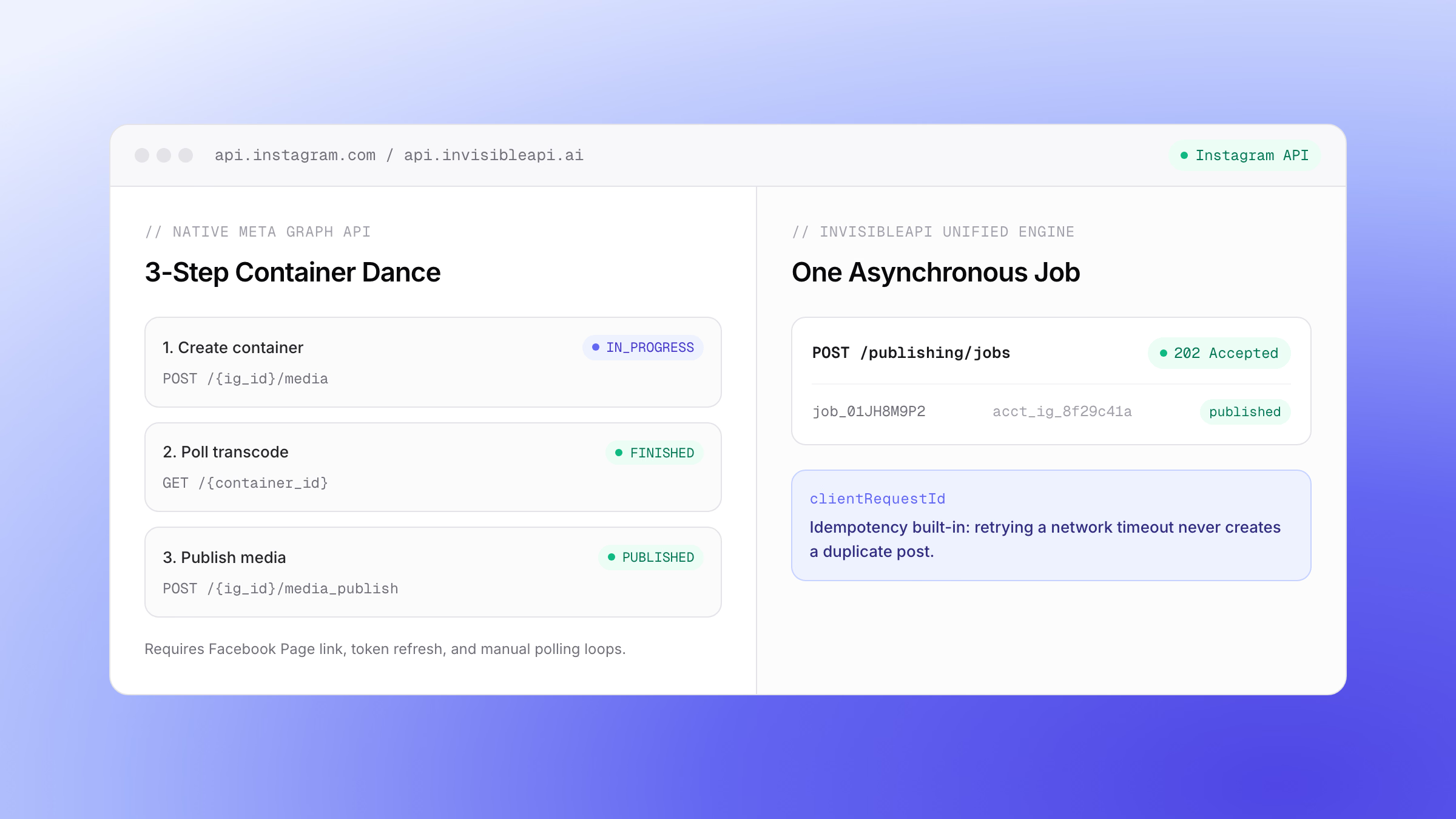
One API instead of the Graph API plumbing. InvisibleAPI is one job-based API for Instagram and X. Connect the account, create a publishing job, poll it until it reaches published.
Get API keyThe five kinds of social media API
| Kind | What it does | Examples | Pick it when |
|---|---|---|---|
| Official platform APIs | Publish and read data on one network | Instagram Graph API, X API, LinkedIn, TikTok, YouTube, Pinterest, Threads, Bluesky | You need one network and can pass its review |
| Unified publishing APIs | One integration that publishes to several networks | InvisibleAPI, Ayrshare, bundle.social, Zernio, Outstand, Postiz | Your users connect their own accounts on several networks |
| Reviews, UGC and social feed APIs | Collect posts and reviews to display or analyze | EmbedSocial API | You show social content or reviews inside a product or site |
| Local listings APIs | Manage Google Business Profiles | Google Business Profile APIs, Localith | You manage locations, hours, reviews and Google posts |
| Social data and listening APIs | Read public social data at scale | Data365, Phyllo, Brandwatch | You need research, monitoring or creator data |
How to choose a social media API
Four questions narrow the list fast:
- Publish or read? Publishing needs write permissions and usually a platform review. Reading public data is a different product category.
- Your accounts or your users’ accounts? Posting to accounts you own is the easy case. Posting on behalf of users means OAuth, advanced access and app review on every network.
- How many networks? One network is often fine to build directly. Each extra network adds an app review, a token model and its own media rules.
- Who runs it: a backend or an agent? If an AI agent will call the API, check for an MCP server instead of writing your own tool wrappers.
Official platform APIs
These are the source of truth. Every unified provider below is built on top of them, so their limits apply no matter which route you choose.
Instagram Graph API
Publishes images, carousels and Reels, and reads insights, for professional (Business or Creator) accounts only. Publishing to accounts you do not own needs Advanced Access through Meta App Review and Business Verification. Meta publishes no usage fee. The hard limit is 100 API-published posts per account in a rolling 24 hours, and a carousel counts as one. Read the Instagram Graph API definition for the basics, the Instagram API tutorial for the container flow, and our breakdown of Instagram API pricing for what it really costs to run.
X API
Publishes and reads posts for any X account through OAuth 2.0. Since February 6, 2026, new developers pay per request: $0.015 per post, and $0.20 per post that contains a URL. The old free tier is closed to new developers, and the legacy Basic and Pro plans remain only for existing subscribers. Posting is capped at 100 posts per 15 minutes per user. Our X API pricing guide works through the math.
LinkedIn API
Posts to member profiles and Company Pages through the Posts API, with Page posting under the Community Management API. New apps start on a Development tier with low daily call caps. Moving to the Standard tier needs a vetting review with a screen recording of your OAuth and posting flow.
TikTok Content Posting API
Publishes videos and photo posts to TikTok accounts connected through Login Kit. Until TikTok audits your app, every post is private (SELF_ONLY), and public posting is blocked. Plan for the audit before you promise TikTok publishing to users.
YouTube Data API v3
Uploads videos and reads channel data. Every project gets a default quota of 10,000 units per day, and you cannot buy more, only request an extension. Since June 1, 2026, video uploads use their own quota of 100 uploads per day by default, separate from the general units.
Pinterest API v5
Creates Pins and Boards and reads analytics. New apps get Trial access, where created Pins are visible only to you. Standard access needs a review that includes a recording of your OAuth flow.
Threads API
Meta’s API for Threads publishes text, images, video and carousels after App Review for the publishing permission. Each profile can publish 250 posts and 1,000 replies per 24 hours, and you can check the remaining quota through the API.
Bluesky (AT Protocol)
The most open option: no app review, and any account can post. OAuth is recommended for apps that act for users. Rate limits are generous and counted in points per hour and per day.
Unified publishing APIs
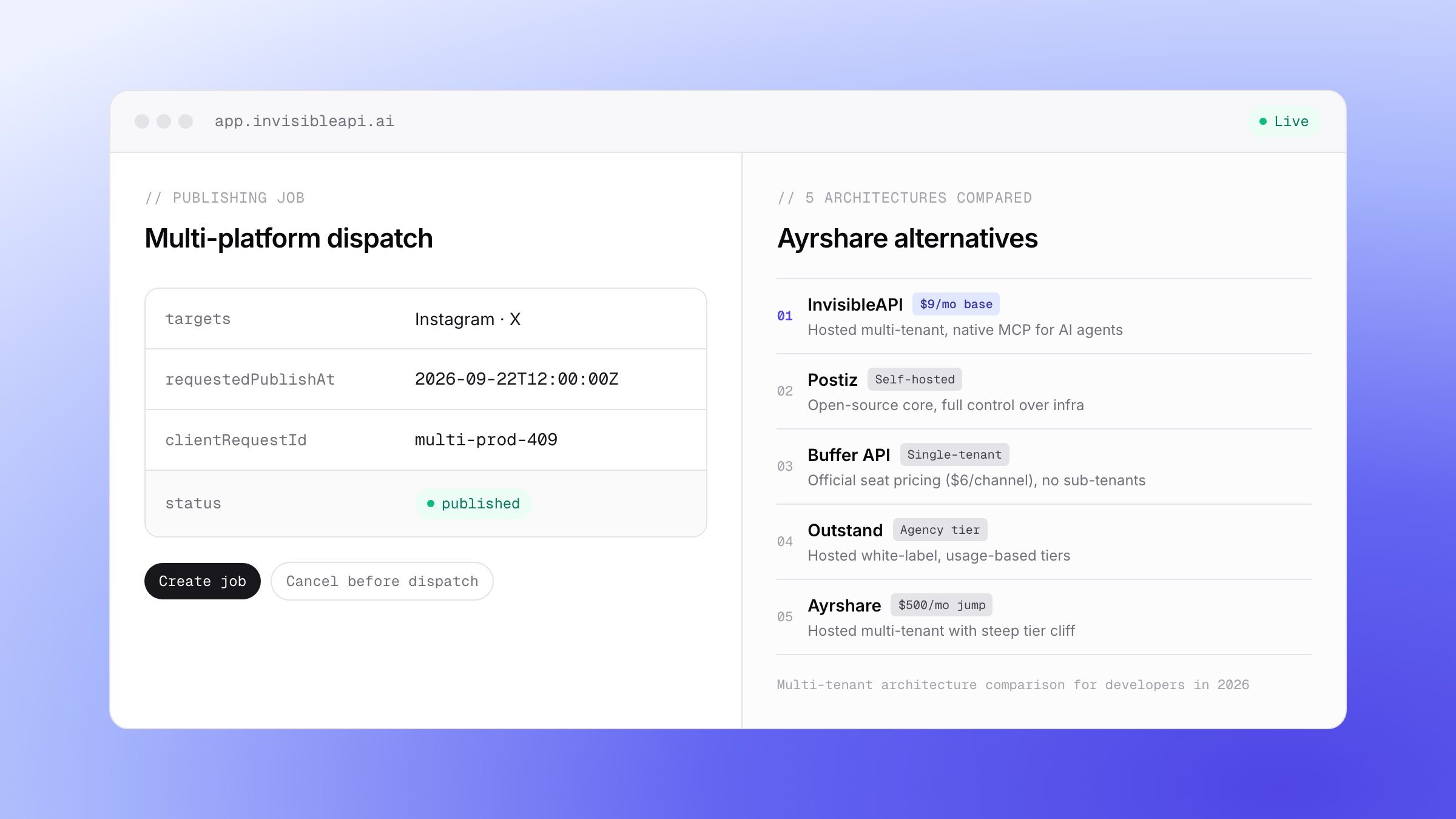
A unified API handles the platform apps, OAuth, token refresh and per-network rules for you, so your code makes one request per post. This is the right category when your users connect their own accounts. For a vendor-by-vendor look at replacing one provider, see our Ayrshare alternatives comparison.
| API | Networks | Pricing model (October 2026) | Agent support |
|---|---|---|---|
| InvisibleAPI | Instagram and X live; TikTok, Facebook, LinkedIn and YouTube coming soon | $9/month for 2 sources, plus $5/month per extra source | MCP server |
| Ayrshare | 13 networks | Per profile; multi-user apps need its higher Business tier | Not native |
| bundle.social | Many networks | Per organization, unlimited accounts; paid plans from $100/month | Not native |
| Zernio (formerly Late) | 15+ networks | Per connected account; the first 2 accounts are free | Not native |
| Outstand | 10+ networks | Base plan with included posts, then billed per post | Supported |
| Postiz | 30+ networks | Open source (AGPL) to self-host, or paid cloud plans | Community MCP |
InvisibleAPI
A social media publishing API for developers and AI agents. Instagram (images, carousels and video published as Reels) and X (text up to 280 characters, up to 4 images or one video) are live today. TikTok, Facebook, LinkedIn and YouTube are coming soon. One publish job can target several connected accounts. You pass media by public URL and can schedule posts. A clientRequestId makes retries safe, and every job reports its status with a failure category, code and retry flag. A social media MCP server lets Claude and other MCP-compatible agents publish through the same jobs. Pricing is one plan: $9 per month including 2 sources, plus $5 per additional source, with a 7-day free trial.
Ayrshare
The longest-running unified API, covering 13 networks with scheduling, analytics and comment tools. Plans are billed per profile, and products where end users connect their own accounts need the Business tier, which is the main reason teams compare alternatives.
bundle.social
Prices per organization rather than per seat, with unlimited connected accounts and users on every plan. That model suits agencies and SaaS products with many accounts and moderate post volume.
Zernio (formerly Late)
Late rebranded to Zernio in 2026 and kept the same API. It covers 15 or more networks, including messaging channels, and bills per connected account with the first two free.
Outstand
Charges for posts rather than accounts: a base plan includes a post allowance, and extra posts are billed per post. It covers 10 or more networks and supports AI agent access.
Postiz
The leading open-source option. You can self-host it for free under the AGPL license and run your own platform apps and reviews, or use its paid cloud plans. It exposes a public API and webhooks.
Reviews, UGC and social feed APIs
EmbedSocial API (our sister product)
The EmbedSocial API returns the social content and reviews that EmbedSocial collects, so you can render them in your own product or site. Verified endpoints cover widget media, single media items, a query endpoint for social feed items, Instagram Stories, filtered reviews and widget analytics. Sources include Instagram, Facebook, TikTok, YouTube, LinkedIn, X, Pinterest, Threads and RSS, and reviews from Google and Facebook. It does not publish to social networks. API access needs the Premium or Custom plan, and a read-only MCP connector exposes the same feeds to Claude and ChatGPT. Start with the API key and docs page.
Local listings APIs
Google Business Profile APIs
Google’s APIs manage business information, reviews and Google posts for verified profiles you manage. Access is by request: you create a Cloud project and submit the access form, and your quota stays at zero until Google approves it. Google charges nothing for the API itself.
Localith (our sister product)
Localith is a Google Business Profile management platform, also built by EmbedSocial. Its REST API provides endpoints for listings management, review aggregation, performance metrics and post publishing, and an n8n node covers reviews, listings and metrics. A read-only Claude MCP connector lets an agent answer questions about locations, metrics and reviews. API access needs a paid Localith account. See the Localith API page.
Social data and listening APIs
These read public social data instead of acting on accounts you manage. Data365 sells credit-based access to public data from networks such as Instagram, TikTok and Reddit. Phyllo reads creator data through creator-consented connections. Brandwatch offers its Consumer Research API to enterprise customers for listening data. All three quote prices through sales, so budget for a sales cycle.
Which social media API fits your project
| Your project | Start with |
|---|---|
| Post to your own company accounts on one network | That network’s official API |
| Let your users publish to Instagram and X from your product | A unified publishing API such as InvisibleAPI |
| Publish to 10+ networks, including niche ones | Ayrshare, Zernio, Outstand or self-hosted Postiz |
| Let an AI agent publish posts | An API with an MCP server |
| Show Instagram posts, UGC or Google reviews on a site | EmbedSocial API |
| Manage many Google Business Profiles | Google Business Profile APIs or Localith |
| Monitor public conversations or creators | Data365, Phyllo or Brandwatch |
If your product publishes to Instagram and X for your users, our social media API lets you skip the app reviews and token handling and send one request per post. Whichever API you pick, platforms change their rules often, so keep an eye on the social media API changelog.
Post to X and Instagram from one API.
Connect the accounts once, create a publishing job, and poll it until it is published. Preflight validation catches a broken post before it reaches the platform, and a clientRequestId makes retries safe.
Sources
- Instagram Platform: content publishing
- X API pricing and rate limits
- LinkedIn: increasing access
- TikTok Content Posting API: direct post
- YouTube Data API: quota costs and revision history
- Pinterest API: access tiers
- Threads API overview
- Bluesky: bot tutorial
- Google Business Profile APIs: prerequisites and pricing
- Ayrshare pricing
- bundle.social pricing
- Zernio pricing
- Outstand pricing
- Postiz pricing
- Data365 pricing
- Brandwatch APIs